Electronic, Digital, Remote: Which Notarization Is Which
Four terms get used interchangeably and mean different things. What separates in-person electronic notarization from remote online notarization, and where a cryptographic record fits.

Three of these terms describe a notarial act and one does not. Electronic notarization is a notary sealing an electronic document while you stand in front of them. Remote online notarization is the same act over live audio and video, with you somewhere else. Digital notary is marketing language, not a category in any statute. Digital notarization usually means one of the first two, and sometimes means a cryptographic timestamp that involves no notary at all.
Getting them confused is expensive in one specific direction: buying a tamper-evident record when a statute demanded a notary, or hiring a notary when what you needed was proof of delivery.
The distinctions that matter
| Term | Notary present? | Signer located | Statutory basis |
|---|---|---|---|
| Traditional notarization | Yes, in person | Same room | State notary law |
| Electronic notarization (IPEN) | Yes, in person | Same room | State notary law, electronic record provisions |
| Remote online notarization (RON) | Yes, over audio-video | Anywhere permitted | State RON statute |
| Cryptographic timestamp / evidence record | No | Anywhere | None. Not a notarial act. |
The first three produce a notarial certificate and a seal. The fourth produces a hash and a timestamp. They are not substitutes, and any vendor implying otherwise is selling you a misunderstanding.
In-person electronic notarization
The document is electronic. The signature is electronic. The notary's seal is electronic. You are still physically present, and the notary still checks your ID the ordinary way.

In-person electronic notarization removes the paper without changing the legal shape of the act. Photo: Towfiqu barbhuiya via Pexels. Pexels License.
This is the least confusing of the three and the least discussed, because it removes paper without changing the legal shape of the act.
Remote online notarization
The act happens over live audio and video. Under the Revised Uniform Law on Notarial Acts, "audio-video communication" is defined as:
"communication by which an individual is able to see, hear, and communicate with a remotely located individual in real time using electronic means"
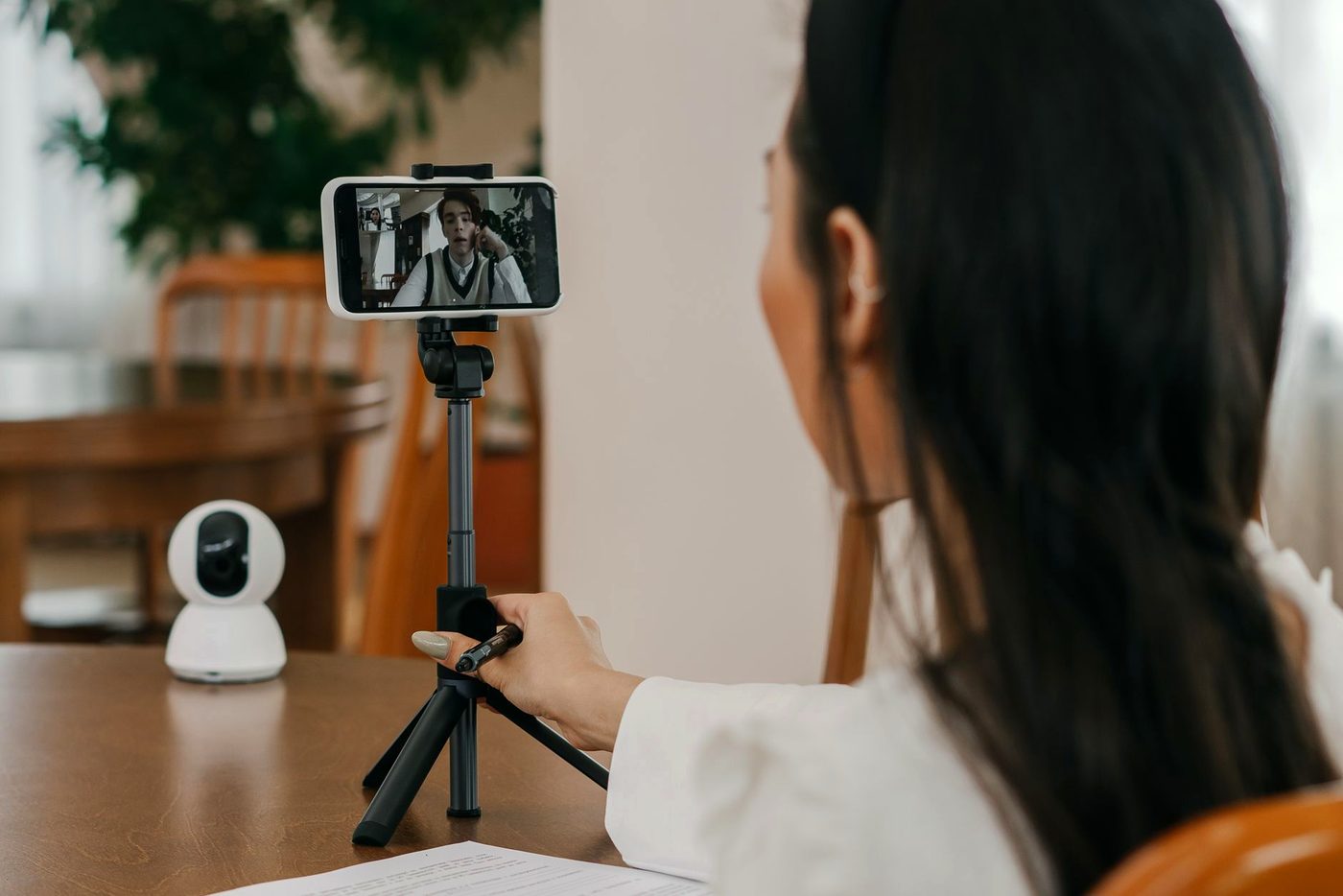
The statutes add machinery in-person notarization never needed: a recording, disclosed and consented to, then stored. Photo: Mikhail Nilov via Pexels. Pexels License.
The statutes add machinery that in-person notarization does not need:
- The certificate must say so. In Colorado's enactment, the certificate for a remote notarization "must, in addition to complying with the requirements of section 24-21-515, indicate that the notarial act was performed using audio-video communication technology."
- A recording is made and kept. The notary creates an audio-video recording, having first disclosed "the fact of the recording and the details of its intended storage, including where and for how long it will be stored", with the signer's explicit consent to both.
- Some records are excluded. Colorado's version bars remote notarization of records "relating to the electoral process", and of wills and codicils outside its Uniform Electronic Wills Act.
- Cross-border limits apply. The notary must have no actual knowledge that the act is prohibited where the signer physically is.
Most states now authorize some form of it. The requirements differ enough that your Secretary of State is the only reliable source for yours.
"Digital notary" is not a legal category
No statute defines one. In practice the phrase is used three ways: a commissioned notary who works remotely, a platform that connects you to one, or a product that timestamps a file and borrows the word for its reassuring shape.

Authority to perform a notarial act comes from a commission granted under state law, not from a product name. Photo: Eyes2Soul Eyes2Soul via Pexels. Pexels License.
The first two are notaries. The third is not, whatever the marketing says. If you need a notarial act, the test is simple and worth applying: is there a commissioned notary performing the act, and will you receive a notarial certificate with their seal and commission details? If no, you did not get one, no matter what the service is called.
Where a cryptographic record actually fits
It answers questions notarization does not reach.

Both approaches make tampering visible. Only one of them is a notarial act. Photo: Heather Green via Pexels. Pexels License.
A notary establishes who signed, at a moment they witnessed. They were not present when you sent the files, they never saw what was inside, and they have no view of whether the other party received or read anything.
A tamper-evident record covers that other ground: what the content was, that it has not changed since, when it existed, and that a named counterparty acknowledged receiving it. That is the useful division of labour, and it is why the two coexist rather than compete.
| Question | Notarial act | Evidence record |
|---|---|---|
| Who signed this? | Yes, identity checked against ID | Partly. Email one-time code, consent, IP, time |
| Are the contents unchanged? | No | Yes, by hash |
| When did this content exist? | Date of the act only | Yes, timestamped independently |
| Did the other side receive it? | No | Yes, if they acknowledged |
| Satisfies a statute demanding notarization | Yes | No |
That last row is not a caveat we bury. Pactbound is not a notary and cannot perform a notarial act. Where a form has a notary block or a statute names one, you need a commissioned notary and nothing else will do.
Which one you need
- A statute, a form, or a counterparty demands notarization. Get a notary. In person or remote, whichever your state allows.
- You need to prove what you handed over and that they took it. A notarial act does not cover this. See how to make a handoff defensible.
- You need to prove a file existed in a given state at a given time. A timestamped hash does this, and does not require anyone's presence. See what is inside a .pactbound file.
Sources
- Revised Uniform Law on Notarial Acts, as enacted in Colorado, section 24-21-502 for definitions and the remote notarization provisions quoted above
- Uniform Law Commission, drafter of RULONA
State requirements vary and change. Confirm yours with your Secretary of State before relying on any of this for a specific transaction.